ChatGPT might be one of the most useful tools you’ll use during your real estate transaction.
It can explain unfamiliar terms, summarize inspection reports, organize your timeline, and help you ask better questions before you pick up the phone.
It can also confidently tell you what your home is worth, suggest negotiation strategies without knowing the facts of your deal, rewrite perfectly good marketing into bland corporate mush, and invent legal information that simply does not exist.
The difference is not the software.
The difference is knowing which jobs belong to the chatbot and which still belong to an experienced human.
Nearly half of agents now report using AI-generated content in their work, according to the National Association of Realtors’ 2025 technology survey, and buyers and sellers are right there with them. If you are in a transaction, odds are you have already thought about running something past ChatGPT. The price your agent gave you. A clause you did not understand. The inspection report. Maybe even a quiet gut check on whether your agent is doing right by you.
First, good for you.
Wanting to understand and verify things yourself is the instinct of a sharp client, and I would never talk you out of it. I hope my clients ask questions. I hope they verify what I tell them. I hope they understand every step of their transaction instead of simply taking my word for it.
ChatGPT can absolutely help you do that.
The whole game is pointing the tool at the right jobs.
Some uses genuinely make you sharper. Others can quietly cost you in a deal this size.
Here is the honest map of which is which.
First, how these things actually work
It helps to know what a chatbot is actually doing, because it explains almost every success and every failure in this article.
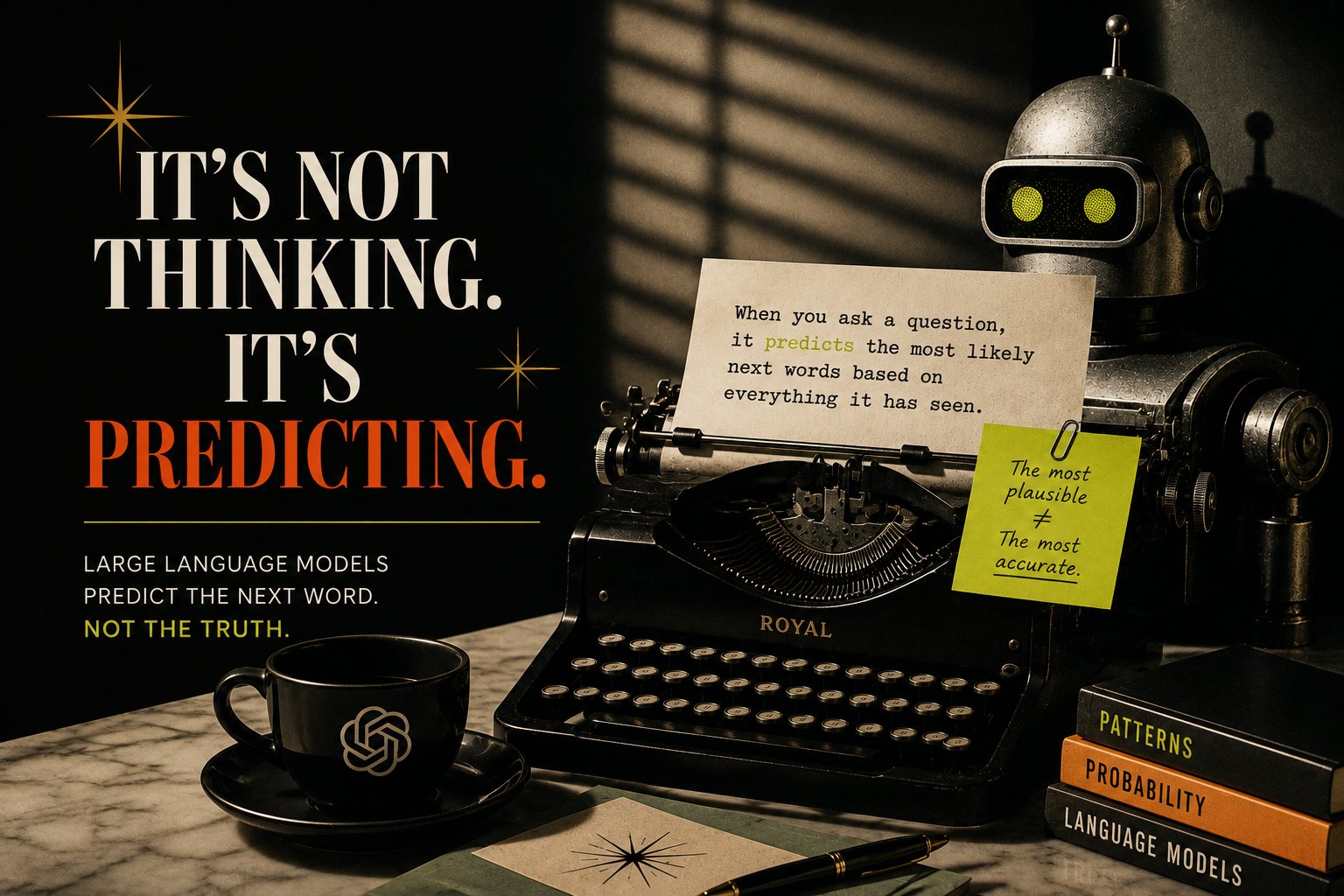
A large language model is not a database, and it is not thinking. It is a prediction machine. It has read an enormous amount of text, and when you ask it a question, it answers by predicting the most likely next words based on everything it has seen. Picture autocomplete with a much bigger vocabulary and a lot more confidence. What it is built to hand you is the most common, most average, most expected answer.
That is the whole problem in a real estate deal, because your situation is usually not the average one.
Ask it to explain what earnest money is, and it will probably do a great job.
Ask it to summarize a forty-page inspection report, and it will probably save you time.
Ask it to explain what an escalation clause does, and it can make you a better informed buyer.
But ask it to tell you what your waterfront home is worth, whether you negotiated well, or whether your inspection response is legally sound, and you’ve crossed into jobs it simply isn’t built to do.
Hallucinations work the same way. When the model does not actually have your answer, it does not stop and admit that. It predicts something that sounds right, which is how you get a made up statute or a comparable sale that never happened. It is not lying to you. It is doing the only thing it knows how to do, predicting the most plausible next words whether or not they are true.
You may be thinking it can just look things up now, and it can.
But turning on web search changes what it reads, not what it does with it.
It skims the handful of results it can reach, leans on whatever ranks highest, blends those sources into a single answer, and presents what looks like a consensus. It is not reading every source in full, weighing conflicting evidence, or checking databases that sit behind professional logins. It cannot see inside the Northwest Multiple Listing Service. It cannot read your transaction file. It cannot know the conversations happening between agents.
Search makes it faster.
It makes it a little more current.
It does not make it a careful analyst.
Understanding that one limitation explains almost everything that follows.
Never hand a chatbot your private information
Before we get into the transaction itself, there is one rule with almost no exceptions.
Never paste sensitive financial or legal information into a public chatbot.
Not your Social Security number.
Not your bank account or routing numbers.
Not your tax returns.
Not your pre-approval letter with account numbers still visible.
Not your title report.
Not your wiring instructions.
Not your legal documents.
Real estate transactions are already one of the biggest targets for wire fraud and identity theft. Saving yourself five minutes by dropping sensitive information into a public AI tool simply is not a trade worth making.
If you need help understanding a document, ask the chatbot about the language, not the document itself. Better yet, ask your agent or the professional who prepared it. That keeps your private information where it belongs.
Now let’s walk through a transaction Ai from beginning to end.

Pricing your home: what Zillow, Redfin, and ChatGPT can and cannot tell you
This is usually the first place people reach for AI, and it is also the place where it is most likely to steer you wrong.
Start with the flat no.
Do not use ChatGPT to tell you what your home is worth.
It has never walked through your front door.
It does not know your kitchen gets incredible morning light.
It cannot smell that three dogs have lived there for the last decade.
It cannot hear the traffic that picks up every afternoon or notice that your backyard suddenly opens to a mountain view once the leaves fall.
Those are the things buyers actually react to, and they are exactly the things AI cannot see.
Turning on web search does not fix that problem because the Northwest Multiple Listing Service, the actual record of what sold, what is pending, and what buyers are doing right now, is not sitting on the open internet waiting to be searched.
Ask ChatGPT what your home is worth and, exactly as the primer explained, it gives you the most statistically likely answer for a house that generally resembles yours.
That is a prediction.
It is not a valuation.
Zillow and Redfin are different tools, and they are worth a glance.
Their estimates are built from real sales data, so they come with a measurable margin of error instead of a shrug.
Just understand what that margin means.
When a home is actively listed, both estimates are surprisingly accurate, with median error rates in the low single digits. That sounds impressive until you realize the estimate is quietly drifting toward the list price itself. In other words, once your home hits the market, the algorithm starts copying the work that an agent has already done.
The number that matters is the one before you list.
That version carries a median error around seven percent nationally, and the error climbs quickly on anything that is not a standard subdivision home.
Waterfront properties.
Acreage.
Custom homes.
Views.
Unique architecture.
Those are exactly the homes algorithms struggle with, because no software can stand in your living room and experience the property the way a buyer will.
That is also why Zillow’s own former chief executive famously sold his Seattle home for roughly forty percent below its Zestimate.
Treat every automated estimate, whether it comes from ChatGPT, Zillow, or Redfin, as one data point.
Never treat it as the answer.
And here is the distinction I wish more homeowners understood.
What your home is worth and where you should position it on the market are two different questions.
One is a rough estimate of value.
The other is a pricing strategy.
Pricing strategy considers current competition, buyer behavior, inventory, seasonality, pending sales, your timeline, and the specific outcome you are trying to achieve.
No chatbot does that.
No Zestimate does that.
That is still where an experienced agent earns every penny of their commission.

Drafting written communication: where AI helps, and where it quietly makes everything sound the same
This is one of the better uses of ChatGPT, with one important caveat.
Use it to get started, not to finish.
A chatbot is excellent at getting you past a blank page. It can help you draft a thank you note to the sellers, organize your thoughts before emailing your lender, or turn scattered notes into a first draft. That is exactly the kind of busywork AI handles well.
Where it gets into trouble is when people assume the first draft is the finished draft.
I see this more often than you might think. I’ll spend time writing listing remarks that capture the personality of a home, then someone runs them through ChatGPT to “make them better.” The result usually sounds like every other listing on the internet.
Suddenly every home is “stunning.”
Every kitchen is “chef inspired.”
Every property is an “unparalleled opportunity.”
Every room is “bathed in natural light.”
The writing is perfectly polished.
It is also perfectly forgettable.
Good marketing is specific. It is supposed to make someone picture themselves walking through your front door, not make them wonder if they’ve read this same listing three times already.
If you use AI to draft something, rewrite it in your own voice. Read it out loud. Delete the phrases you would never actually say. Break up the long dashes. Make it sound like a human wrote it, because the person reading it is still human.
There is one other place to be careful.
If you ask AI to write anything that could become part of the marketing for a home, verify every fact before it leaves your computer. AI will confidently invent square footage, permitted additions, nearby amenities, and neighborhood details that simply are not true. It also has a habit of drifting into fair housing language without realizing it. Phrases like “perfect for a young family” or “picture your kids in the backyard” sound harmless, but they describe the buyer instead of the property, and that is exactly what fair housing rules tell us not to do.
The rule is simple.
Describe the house.
Never the person you hope will buy it.

Photos: AI can stage a room. It cannot change reality.
The next place AI shows up in a transaction is usually before you’ve even stepped through the front door.
Light editing has always been part of real estate photography. Adjusting brightness, correcting color, or replacing an overcast sky with one that actually reflects the weather that day has become fairly standard.
Virtual staging can also be genuinely helpful. An empty room is hard for many buyers to imagine living in. Adding furniture helps people understand the space.
The problem is that AI no longer stops at furniture.
In one demonstration I watched, the software pulled the camera farther back to make the room appear larger, brightened the entire space, enlarged the window, and even created a reading nook that simply did not exist.
That is where marketing crosses into misrepresentation.
If you’re buying, treat listing photos the way you’d treat a dating profile.
Expect them to show the house on its best day.
Do not expect them to tell the whole story.
Always walk the property yourself.
Always ask if any images have been virtually staged.
If you’re selling, the standard is just as straightforward.
Use AI to help buyers visualize the home.
Do not use it to hide the home.
Adding a couch is one thing.
Removing a water stain.
Erasing the neighbor’s RV.
Covering foundation cracks.
Deleting power lines.
Those are completely different conversations.
The moment editing begins hiding defects instead of helping buyers imagine possibilities, you’ve left marketing behind and entered misrepresentation.
The best marketing builds trust.
It doesn’t manufacture it.

Negotiations: use ChatGPT to ask better questions, not make better offers
This is probably the smartest place to use AI, provided you give it the right job.
Absolutely use ChatGPT to understand the negotiation process.
Ask it to explain escalation clauses.
Ask it what inspection credits are.
Ask it what questions you should ask your agent before accepting an offer.
Ask it what usually happens after a counteroffer.
That kind of preparation makes you a better informed client, and better informed clients are wonderful to work with.
Where things go sideways is when people ask the chatbot to evaluate the deal itself.
“Did I overpay?”
“Should I counter?”
“Was this a good offer?”
Those sound like reasonable questions.
They’re also impossible for AI to answer.
It does not know how many offers were on the table.
It does not know what the listing agent revealed during a phone call.
It does not know whether the seller needs to close by the end of the month because they’ve already bought another house.
It does not know that the home next door fell out of contract yesterday.
It cannot read personalities.
It cannot read pressure.
It cannot read a room.
So instead, it gives you what it always gives you.
The statistically average answer.
Sometimes that answer will sound perfectly reasonable.
Sometimes it will quietly cost you the house.
Or thousands of dollars you never needed to spend.
Use ChatGPT to become a more informed participant in the conversation.
Then ask your agent why they’re recommending a particular strategy.
A good agent should be able to explain every recommendation they make.
Not because the chatbot questioned it.
Because you deserve to understand the reasoning behind one of the biggest financial decisions you’ll ever make.
One more caution while you’re here.
Do not paste your offer terms, your walk-away number, or your financial information into a public chatbot. Negotiating positions are meant for the people sitting at the table, not for software you don’t control.

Inspection reports: let it summarize, not decide
Inspection reports are designed to be thorough, and if you’ve never read one before, they can be overwhelming. Forty pages later, everything feels like an emergency.
This is one of ChatGPT’s best jobs.
Paste in the text and ask for a plain-English summary. Ask it to explain unfamiliar terms. Ask it to organize the findings into categories so you know what deserves a closer look.
As a way to orient yourself before talking to your agent, it is genuinely useful.
Where it quietly gets you into trouble is when you ask it to tell you what matters.
A chatbot naturally leans toward caution because it has no context. Every loose handrail becomes a safety concern. Every aging water heater becomes an imminent failure. Every note starts sounding equally urgent.
Real houses are not like that.
Every inspection contains dozens of observations. Most are routine maintenance. Some are worth negotiating. A few can change the economics of the deal entirely.
Knowing the difference is where experience matters.
The chatbot cannot tell you what it will actually cost to replace a roof in Kitsap County.
It cannot tell you which findings sellers routinely credit around here and which ones they almost never touch.
It cannot tell you whether asking for one more repair is likely to keep the deal together or push the other side toward walking away.
Those aren’t inspection questions.
They’re negotiation questions.
And negotiations are still human work.
One hard line deserves its own paragraph.
Never ask a chatbot to draft your inspection response or a contract addendum.
AI is very good at producing documents that look legal.
It is not good at producing documents that are legally correct.
Sometimes it invents Washington statutes that do not exist.
Sometimes it misunderstands deadlines.
Sometimes it leaves out language that protects you.
A defective addendum is not an embarrassing typo.
It can cost you your contingency, your earnest money, or your legal rights.
That belongs in the hands of your agent and, when it becomes custom legal language, an attorney.

Where ChatGPT genuinely shines: your timeline and checklist
There is one job ChatGPT does exceptionally well throughout a transaction.
Keeping you organized.
Buying or selling a home comes with a surprising number of deadlines, appointments, documents, and moving parts.
Inspection.
Financing.
Appraisal.
Title review.
Walkthrough.
Closing.
Drop your important dates into ChatGPT and ask it to build a plain-English timeline or a checklist of what usually happens next.
It is remarkably good at turning a confusing process into something that feels manageable.
Just remember what it is organizing.
Your understanding.
Not your contract.
Always verify every deadline against the signed purchase and sale agreement and with your agent.
If those two disagree, the contract wins every time.
Think of ChatGPT as your personal project manager.
Not your transaction coordinator.
Recording meetings: one AI feature I genuinely like
This is another use I happily recommend, with one important condition.
AI note-taking tools can record a meeting, produce a transcript, and summarize action items afterward.
That means everyone spends less time writing notes and more time actually listening.
For a transaction full of details, that’s a real benefit.
There is one catch.
Washington is a two-party consent state.
Everyone participating in the conversation has to agree before it is recorded.
Not just you.
Everybody.
That applies whether you’re recording with your phone, smart glasses, or an AI transcription tool running quietly in the background.
So ask first.
Get a yes.
Then let the software do the note taking.
If someone records without telling you, that is worth asking about immediately. Your finances, family situation, or personal circumstances may now be sitting inside a system you never agreed to use.
A good tool becomes a bad one the moment it ignores consent.
The rule of thumb that actually works
If you’ve forgotten everything else in this article, remember this.
Use ChatGPT to understand.
Use it to organize.
Use it to draft.
Never use it to decide.
If getting the answer wrong would cost you money…
Cost you a legal right…
Or expose your private information…
You’ve given the chatbot the wrong job.
That is the line.
And it is a surprisingly clean one.
The part a chatbot cannot do
Strip everything in this article down and you end up in one place.
The tool is only ever as good as the judgment steering it.
ChatGPT can summarize your inspection report.
It cannot stand in your kitchen and tell you which finding is worth five thousand dollars at the negotiating table and which one is simply part of owning a home.
It can explain what an escalation clause is.
It cannot hear the hesitation in another agent’s voice and know whether one more push wins you the house.
It can estimate.
It cannot walk your property.
It can predict the most likely answer.
It cannot know your answer.
That’s still a human job.
And honestly, that’s a good thing.
Technology should make you a better informed buyer or seller.
It should never replace the judgment that protects you when the stakes are this high.
So use ChatGPT.
Ask it questions.
Challenge your assumptions.
Learn everything you can.
I genuinely hope my clients do.
Just keep the chatbot for your questions.
Keep a person for your decisions.
Catt Johnson is a licensed real estate broker (License #25004641) with Neighborhood Experts Real Estate, serving Gig Harbor, Port Orchard, Kitsap County, Pierce County, and the greater South Sound. This post is general information and should not be considered legal advice.
Sources
HousingWire — https://www.housingwire.com/articles/ai-fair-housing-remarks-checklist/
Coraly — https://coraly.ai/en/blogs/how-ai-property-descriptions-are-transforming-real-estate
Nila June — https://nilajune.com/ai-listing-descriptions
Irina Norrell — https://irinanorrell.com/how-accurate-is-zillows-zestimate/
AgentsGather — https://agentsgather.com/zillow-estimates-how-accurate-are-zestimates-in-2026/
Own Luxury Homes — https://www.ownluxuryhomes.com/markets/national/zillow-ai-accuracy/how-accurate-is-zillow-zestimate-2026
Ronit Abraham — https://ronitabraham.com/blog/the-online-real-estate-data-problem-accuracy-vs-perception
Realtor AI Guide — https://www.realtoraiguide.com/articles/fair-housing-compliance-when-using-ai
Amplifiles — https://www.amplifiles.ai/blog/real-estate-advertising-rules